Imagine the gentle tap of snowflakes falling, the delicate rustle of frost-covered branches, or the soothing whisper of a winter breeze. These sounds, so subtle yet profound, evoke a tingling sensation that begins at the scalp and flows down the spine, often described as deeply relaxing, even euphoric. ASMR is more than just a feeling—it’s a journey into mindfulness, offering a reprieve from the demands of modern life.
At ARTECHOUSE, we’ve always explored the intersection of art and sensory immersion, and ASMR is no exception. Through carefully crafted visuals and sounds, our winter exhibition becomes a sanctuary of serenity. From the rhythmic crackle of ice forming to the soft twinkle of lights that mimic a starlit night, every element is designed to evoke peace and wonder.
Why ASMR?
ASMR has gained global recognition for its ability to reduce stress, enhance sleep, and provide comfort. Whether it’s the subtle hum of a whisper or the crisp sound of fingers brushing through frost, ASMR creates a profound connection between the senses and emotions. It’s a reminder that beauty often lies in the quiet moments we overlook.
What to Expect
This season, we’ve transformed our space into a multi-sensory retreat. Picture this:
- Snow falling in delicate patterns, each flake accompanied by its own soft, crisp sound.
- Gentle whispers paired with visual projections of serene forests and winter wonderlands.
- Interactive displays where your touch activates soft, resonant tones and tactile sensations.
A Holiday Escape
In the midst of holiday chaos, ARTECHOUSE offers you a moment to breathe. Step inside and let the soothing sounds and mesmerizing visuals transport you. Whether you’re seeking peace, inspiration, or a new way to experience art, our ASMR exhibition promises a unique blend of science, art, and sensory wonder.
So, slow down. Listen. Feel. Let every sound and shimmer bring you closer to serenity.
Tingle Bells is opening soon. We can’t wait to share this tranquil journey with you.
Culturally speaking, our fear of AI is irrevocably tied to the ‘robot takeover’ trope, widespread across the history of film — from the haunting depiction of the HAL-9000 computer from 2001: A Space Odyssey to the heartbreaking story of David in Steven Spielberg’s 2001 film, A.I.: Artificial Intelligence — originally conceived by Stanley Kubrick in the ‘70s as a futuristic retelling of the Pinocchio legend.
Fast forward to the 21st century, robots haven’t taken over, and artists have begun utilizing AI (algorithms, machine learning, etc.) both as a tool to help produce art, and as a framework that allows for different experiences interacting or experiencing it. These advancements AI have ushered a new age of creation expression, from Harold Cohen’s AARON computer, which codified the act of drawing, to the eerie portraits of Mario Klingemann and the collaborative AI paintings of Sougwen Chung, to exhibitions that we have produced and presented over the years, including Everything in Existence and TRUST both by fuse* and Transient: Impermanent Paintings by Quayola.
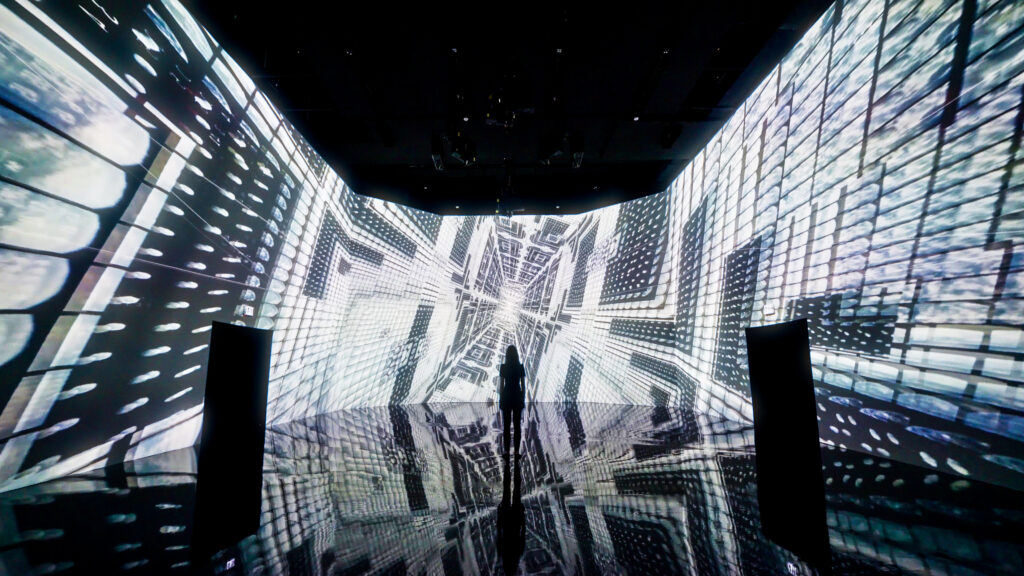
As we look at the intersection of AI in art in the modern day, there is arguably no figure who has garnered more attention as Turkish new media artist Refik Anadol. Born in Istanbul in 1985, Anadol watched Blade Runner when he was eight and recalls the “profound” effect it had on his imagination. In that same year, his family bought a home computer. This early fascination with film and technology would come to anticipate the immersive data sculptures he is globally known for today. Much like Do Androids Dream of Electric Sheep?, the dystopian novel that inspired Blade Runner, Anadol has built his career pondering on the question: If machines can learn, can they dream?
Instead of pigment, Anadol uses data sets and machine learning as his material of choice to paint breathtaking installations that challenge our perception of space, time and narrative. Surely by now, you’ve seen his work. Whether across historical architecture, such as Barcelona’s Casa Battló, Florence’s Palazzo Strozzie and Los Angeles’ Walt Disney Concert Hall, to his latest solo exhibition at Jeffrey Deitch and the monumental installation at the Museum of Modern Art in New York City, ‘Unsupervised”.
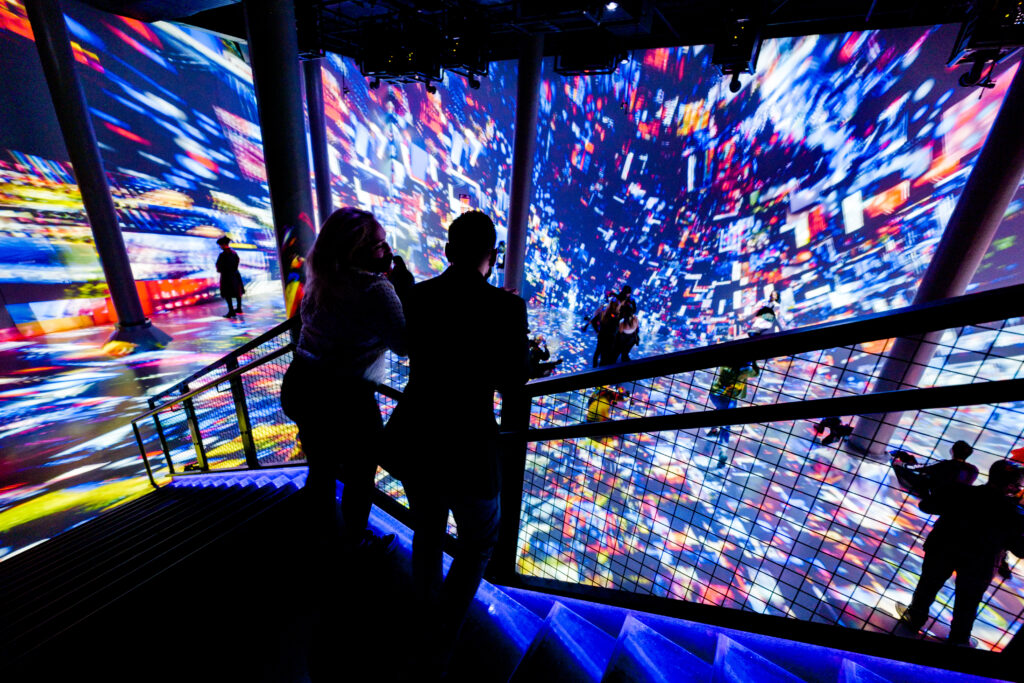
But looking back to 2019, we had the opportunity to introduce Anadol to the states — utilizing ARTECHOUSE’s technological infrastructure to collaborate on his first solo exhibition in the US. We have worked side-by-side with the artist on four collaborations, including Infinite Space in DC and Miami, and Machine Hallucination, which launched ARTECHOUSE NYC in 2019, and then was reprised in 2021 due to popular demand along with a monumental NFT release.
“If the doors of perception were cleansed,” wrote the acclaimed English artist William Blake, “everything would appear to man as it is — infinite.” Anadol approached Infinite Spaces with this conceptual framework in mind. Housed at both our DC and Miami locations, the exhibition was defined by a rhythmic and pulsating energy that aimed to explore memories and dreams through the mind of a machine using data sets from human ephemera, intergalactic photographs, along with historical archives and geological activity. These were then translated into hypnotizing sculptures and living paintings in a context that astounded audiences..
Boxes were fabricated that allowed visitors to step inside the idea of infinity, as opposed to observing a concept simply on a flatscreen. “What was really unique about the ARTECHOUSE project, I was able to finally find a place where I can compile all the ideas in one location, one point of view where people can immerse themselves with similarities on the surface, but depth is still available.”
Within each collaboration, Anadol has looked to shape and reshape the way in which we understand the natural and built environment. Machine Hallucination was created by using 100 million architectural images of New York, which were then reimagined across an immersive environment that emitted the city’s collective memories and its potential future. “When I saw the technological infrastructure in New York, that was it,” recalled Anadol, when reflecting on how he first worked with our studio. “It’s the future of cinema. And I think we’ve made it.”
While some fear the capabilities of AI, Anadol reasserts that science, art and technology have always been interlinked throughout the centuries. One only needs to think of the great Leonardo Da Vinci to be reminded of this fact. Like an invisible ray of light, Anadol is “trying to find the poetry inside those datasets to create a new meaning beyond what data means.”
Despite his unflinching optimism, Anadol isn’t naive to the dangers that can be brought on by AI if used in the wrong hands. “Purposeful questions and purposeful reason” will be needed in bringing stability and progress for all sectors of society and not just a select few, he asserts. “Can we use AI to enhance our cognitive capacity? Can we learn better? Can we remember better? What would happen if we had the chance to create a machine that enhanced our capacity of imagination?”
]]>There has never been a time more saturated with information than in the present day. Images, news reels and articles race across the light of our eyes at blinding pace, where our attention spans have shortened and the question of truth has become a hotly debated conversation — what is real and what is fake?
One of the roles of art has always been to elucidate certain overlooked truths of the outside world and those from within. While many artists use a pencil or paintbrush to bring their creations to life, Shohei Fujimoto uses that which is largely immaterial to reveal the threshold between the physical world and the metaphysical realms of our mind.

Born and raised in Japan’s Kumamoto prefecture, located on the island of Kyushu, the Tokyo-based artist grew up surrounded by nature and recalls the landscape leaving a deep imprint on his memories. Hidden subtly within the shrubs, the changing degrees of light became the medium in which the artist sought to understand the world. This fascination began to deepen in 2013, as the artist noticed a wall reflecting a laser beam and feeling something physical. “It was like the laser was an object existing right between the wall and myself. That was interesting and I thought maybe I could use it as a piece of data inside a living space,” Fujimoto told ARTECHOUSE.
“You will be able to imagine the world as others see it.”
Since then, the Japanese artist has utilized mathematical code to create otherworldly light installations that probe into the boundaries of human perception. Naturally, music has become a complementary field to his work, which has featured alongside hypnotizing sets and solo exhibitions across the world. When asked about the motives behind his art, Fujimoto asserts that he looks to reawaken his audience to their mind’s eye — that is, our universal ability to imagine disparate images from the same source of information. An effort he hopes will encourage people to observe the world with empathy, mindful of our unique perspectives and how consciousness itself is nothing more than an ever-changing mix of memories, aspirations and worldviews.

“The ability to share images with others is a unique characteristic of human beings, and if you see or experience art that reminds yourself of that ability, you will be able to imagine the world as others see it. This will allow you to look inward, observe yourself and connect with the world you see yourself,” he muses.
Fujimoto’s latest exhibition, Intangible Forms, falls succinctly in line with this lifelong exploration. The work on view was produced in collaboration with Kyoka Sound, ARTECHOUSE Studio and is currently on view in Washington D.C. While some installations immerse audiences in a sea of red beams, others theoretically explore the geometry of nature and the synapses in our brains, such as the ability to “make visible the experiences of living things, lifeless things and all the invisible things in between,” noted the artist.
“I would like to invite my audience to experience what is in front of you.”
Revisiting the role of art: ownership and by extension vanity, has been a double-edged sword throughout the course of history. For Fujimoto, however, the autonomous nature of his works allow him to bring a universality to each installation. By removing the artist’s hand and cultural background, per say, Fujimoto programs the clues to which anyone can piece together a story within their own minds. “I would like to invite my audience to experience what is in front of you, to feel how you are experiencing it, and to think about how you are reacting to it,” he added.

Though programmed by the artist, each laser metaphorically takes on its own nature. “We can think about it as a body that moves at a speed we cannot catch or grasp. It’s similar to the behavior of an insect or animal.”
Intangible Forms includes installations dating back as early as 2009, but Fujimoto first brought them together as a fully realized exhibition in collaboration with ARTECHOUSE Studio at ARTECHOUSE’s New York City location in 2020. The exhibition then traveled to Montreal last year. Fujimoto has continually evolved his focus and practice to zero-in on our “universal sense” that is elicited through each autonomous element programmed. “By creating devices and aggregates that imitate natural phenomena, I think that the technology contained in the device can highlight the existence between living things and inanimate objects,” said Fujimoto, adding that this connection will spark a symbiotic relationship where the viewer will subsequently “recognize the consciousness of the thing in focus and the thing will welcome the viewer as an observer of consciousness.”

Fujimoto’s work transcends that of just visceral light and abstract soundscape. The Japanese artist is helping to define the trajectory that art and science will continue to play in the 21st Century — where our digital lives and physical experiences will continue to blur, producing previously unseen visions of consciousness and a deeper need for connection.
Learn more about Fujimoto on his website or in our Artist Spotlight video companion: